Patient profiles the device was studied in, how to order, what the report contains, and an honest comparison against scintigraphy, the motility capsule and manometry.
Patients and caregivers What six days of wear is likePlain language: what the patches do, what you can eat and do, what the test tells your doctor, and how your data is handled.
Billing and practice managers Coding, components and coverageThe code, its Category III status, who bills which component, and a plain statement that payment is discretionary and varies by payer and jurisdiction.
Six days of GI function, measured at home.
GutTracker records myoelectric activity from the stomach, small intestine and colon at the same time, continuously, for up to six days, while the patient eats their own food and lives their own life.
A GutPrint: a frequency spectrum of gastrointestinal myoelectrical activity, with a gastric band near three cycles per minute and a broader intestinal band from about five to twenty-eight cycles per minute spanning the small intestine and colon.
Six days of ordinary life, recorded.
Three patches on the abdomen record while the patient goes about their day. The patches pair to a phone, the phone streams to a secure cloud, and the finished study returns to the ordering clinician as a report. Nothing about the day has to change.
Six days of gut function, recorded where the symptoms happen.
Gastric emptying scintigraphy remains the guideline-referenced standard for solid-meal emptying, and GutTracker neither replaces it nor measures emptying. What GutTracker adds is the myoelectrical signal of the gut's smooth muscle, sampled long enough that day-to-day variation becomes visible rather than invisible.
Three organs at once
Stomach, small intestine and colon are recorded simultaneously and assigned to organ by dominant frequency, rather than one organ per study.2
Up to six days
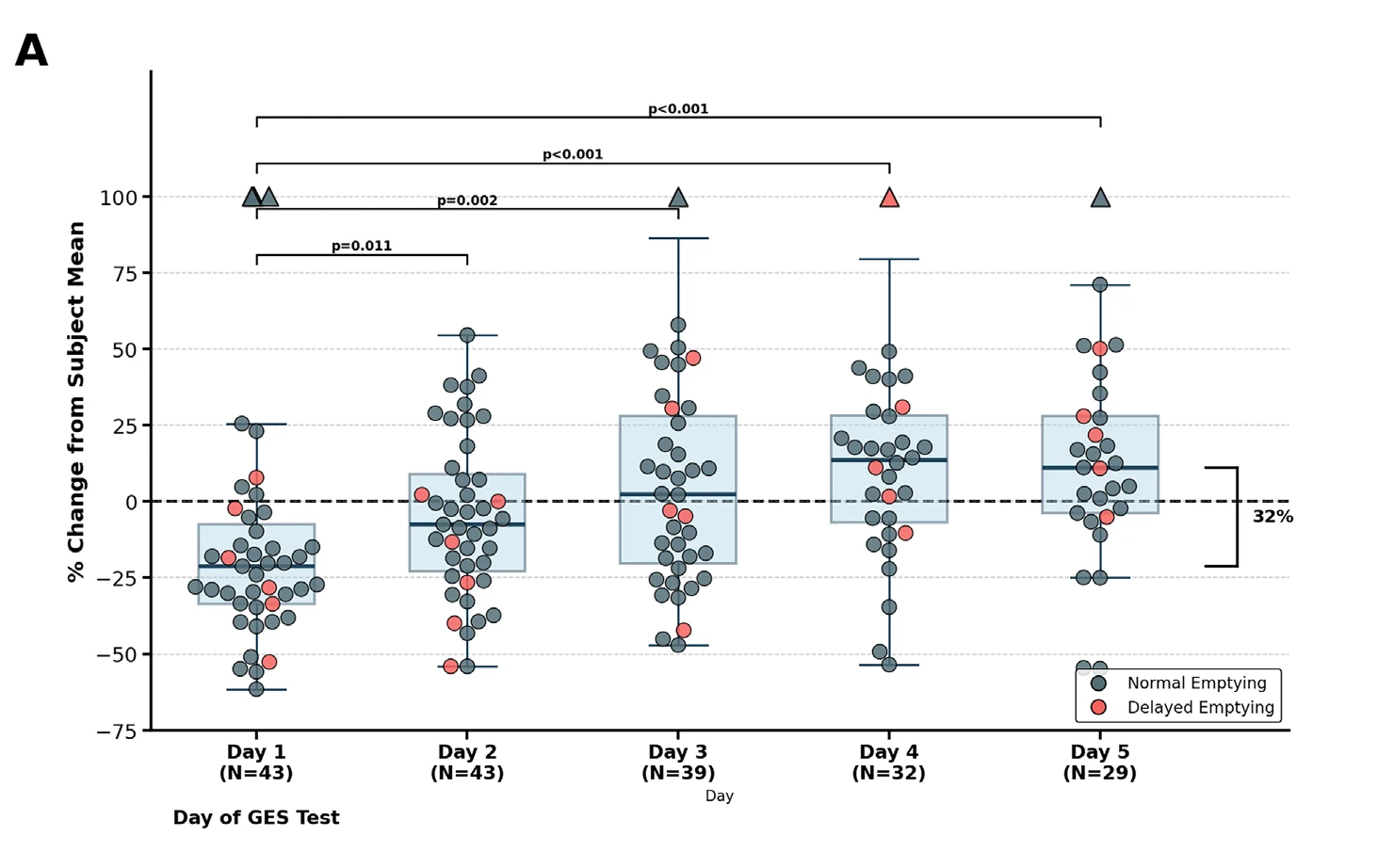
A single four-hour window can classify the same stomach as normal, rapid or slow depending on which day it is sampled.3
At home, on their own food
The recording happens during ordinary life, not during a fasted clinic visit on a standardized meal.4
Surface signal, internal truth
In ambulatory pigs, external patches and implanted serosal electrodes recorded simultaneously for six days with clear spectral congruence.2
Zero procedure room time. Zero staff hours during the recording.
The test runs in the patient's kitchen and bedroom for six days. Nobody sits in your reclining chair, nobody occupies a procedure room, and no technician is scheduled for the duration.
- See underlying three-region function. Multi-day testing smooths out the day-to-day variability lost in a 4-hour window. Patients are tested at home, on their own routine, with no lab visit required.
- Place the order. Kits ship directly to the patient or to the site.
- The patient records. Three patches, up to six days of wear, an app-based diary of meals, symptoms and bowel movements.
- Read the report. Per-organ activity levels, meal response, colonic night:day ratio, and a diary overlay.
GI diagnostic modalities.
| Modality | What it measures | Duration |
|---|---|---|
| Gastric emptying scintigraphy | Solid-meal gastric emptying, directly. The guideline-referenced standard within that scope. | Typically 4 hours, in clinic |
| Wireless motility capsule | Luminal pressure, pH and transit at the capsule's current location | Single pass |
| Antroduodenal manometry | Luminal pressure at fixed sensor positions | Hours, catheter-based |
| GutTracker | Myoelectric activity of stomach, small intestine and colon, at the skin surface2,4 | Up to 6 days, ambulatory |
Four peer-reviewed papers.
The most recent is the Mayo Clinic Jacksonville study of adults referred for gastric emptying scintigraphy on suspicion of gastroparesis, published in Neurogastroenterology & Motility in 2026.
References
- Lacy BE, Cangemi DJ, Axelrod L, Axelrod S, Navalgund A. Beyond the snapshot: overcoming GES limitations to characterize gastric phenotypes and therapeutic responses using a 6-day ambulatory wearable monitor. Neurogastroenterology & Motility. 2026;38:e70413. doi:10.1111/nmo.70413 Source (opens in a new tab)
- Salimi-Jazi F, Thomas A-L, Rafeeqi T, Diyaolu M, Wood LSY, Axelrod S, Navalgund A, Axelrod L, Dunn JCY. Gastrointestinal myoelectric measurements via simultaneous external and internal electrodes in pigs. Journal of Surgical Research. 2022;279:119–126. doi:10.1016/j.jss.2022.05.012 Source (opens in a new tab)
- Lacy BE, Cangemi DJ, Accurso JM, Axelrod S, Axelrod L, Navalgund A. A novel pilot study to evaluate the efficacy and safety of a wireless patch system in patients with chronic nausea and vomiting. Neurogastroenterology & Motility. 2024;36(9):e14862. Source (opens in a new tab)
- Axelrod L, Axelrod S, Navalgund A, Triadafilopoulos G. Pilot validation of a new wireless patch system as an ambulatory, noninvasive tool that measures gut myoelectrical signals: physiologic and disease correlations. Digestive Diseases and Sciences. 2020. Source (opens in a new tab)