A wireless patch system that reads the gut's own electrical rhythm.
Three cutaneous patches record myoelectric activity from the stomach, small intestine and colon, assign each signal to an organ by its dominant frequency, and turn six days of recording into a single readable spectrum, the GutPrint.
From skin to report.
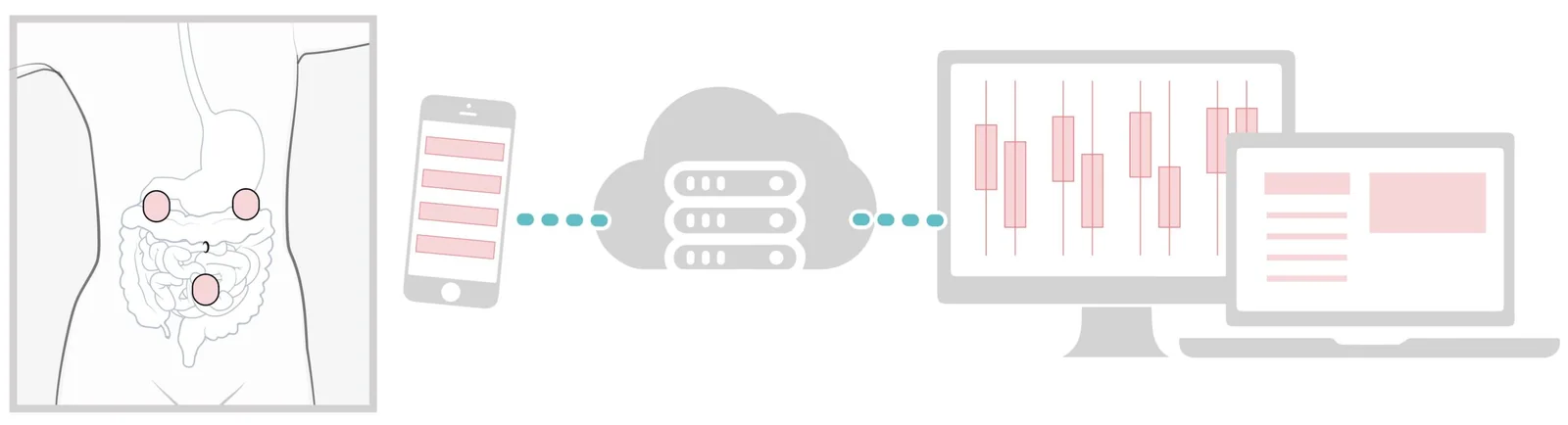
The patches sit on the abdomen and record the low-frequency electrical activity produced by gastrointestinal smooth muscle. The signal is relayed through a phone app to the cloud, analyzed, and returned as a per-organ report. The patient keeps a diary of meals, symptoms and bowel movements in the same app, so the recording can be read against what the patient was actually doing.
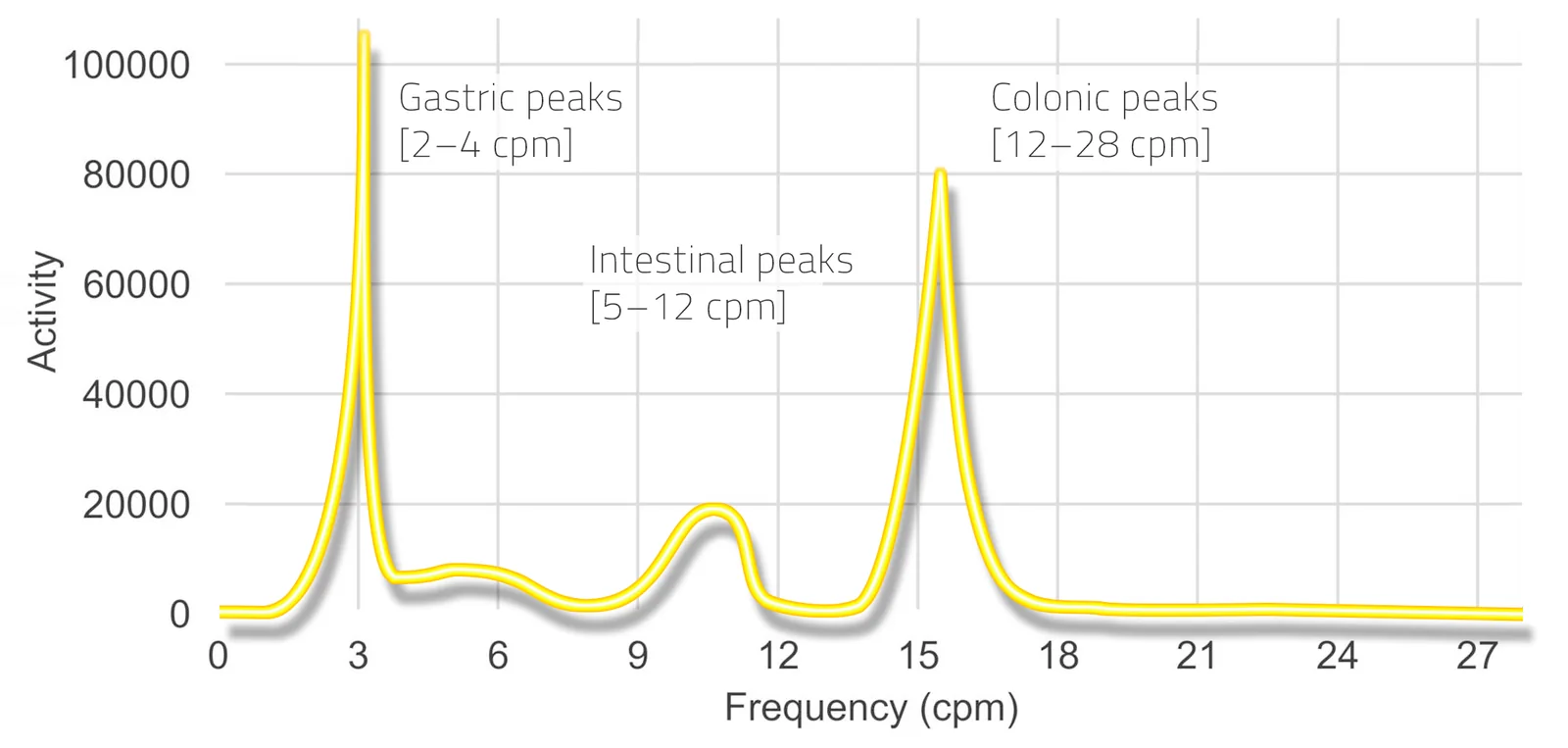
Organ assignment is made by dominant frequency, using the same bands the GutTracker report prints on its charts: gastric activity at about 2 to 4 cycles per minute, small-intestinal at about 5 to 12, and colonic at about 12 to 28.1
Six days of signal in one picture.
A GutPrint is the frequency spectrum of the recording, with distinct peaks for each organ. Because it is built from days rather than hours, it shows structure a single window cannot: the day-to-day variation of gastric activity, the day and night rhythm of the colon, and the response to a meal.2
The pattern is stable enough to be recognizably a given patient's own when repeated over two or three years, and it changes in ways that track physiology, for example losing the 3 cycle-per-minute stomach peak in a patient without a functioning stomach.3
The GutTracker overview.
A single-page overview of what GutTracker measures, how the study runs, and how the report reads. Open the preview for the full one-pager, or download it to print or share.
What it is cleared to do.
The intended use cleared under K212954:4
To serve as a tool that provides gastric and intestinal myoelectrical activity measurements to be used at the discretion of the Physician or Clinical User to aid in the diagnosis and evaluation of gastrointestinal disorders.
It does not diagnose any specific condition and does not measure gastric emptying.
References
- Salimi-Jazi F, Thomas A-L, Rafeeqi T, Diyaolu M, Wood LSY, Axelrod S, Navalgund A, Axelrod L, Dunn JCY. Gastrointestinal myoelectric measurements via simultaneous external and internal electrodes in pigs. Journal of Surgical Research. 2022;279:119–126. doi:10.1016/j.jss.2022.05.012 Source (opens in a new tab)
- Lacy BE, Cangemi DJ, Accurso JM, Axelrod S, Axelrod L, Navalgund A. A novel pilot study to evaluate the efficacy and safety of a wireless patch system in patients with chronic nausea and vomiting. Neurogastroenterology & Motility. 2024;36(9):e14862. Source (opens in a new tab)
- Axelrod L, Axelrod S, Navalgund A, Triadafilopoulos G. Pilot validation of a new wireless patch system as an ambulatory, noninvasive tool that measures gut myoelectrical signals: physiologic and disease correlations. Digestive Diseases and Sciences. 2020. Source (opens in a new tab)
- U.S. Food and Drug Administration. 510(k) premarket notification K212954, G-Tech Medical wireless patch system. Source (opens in a new tab)